We Are All One Family Wolves and Humans Exhibit
General Information About Coyotes
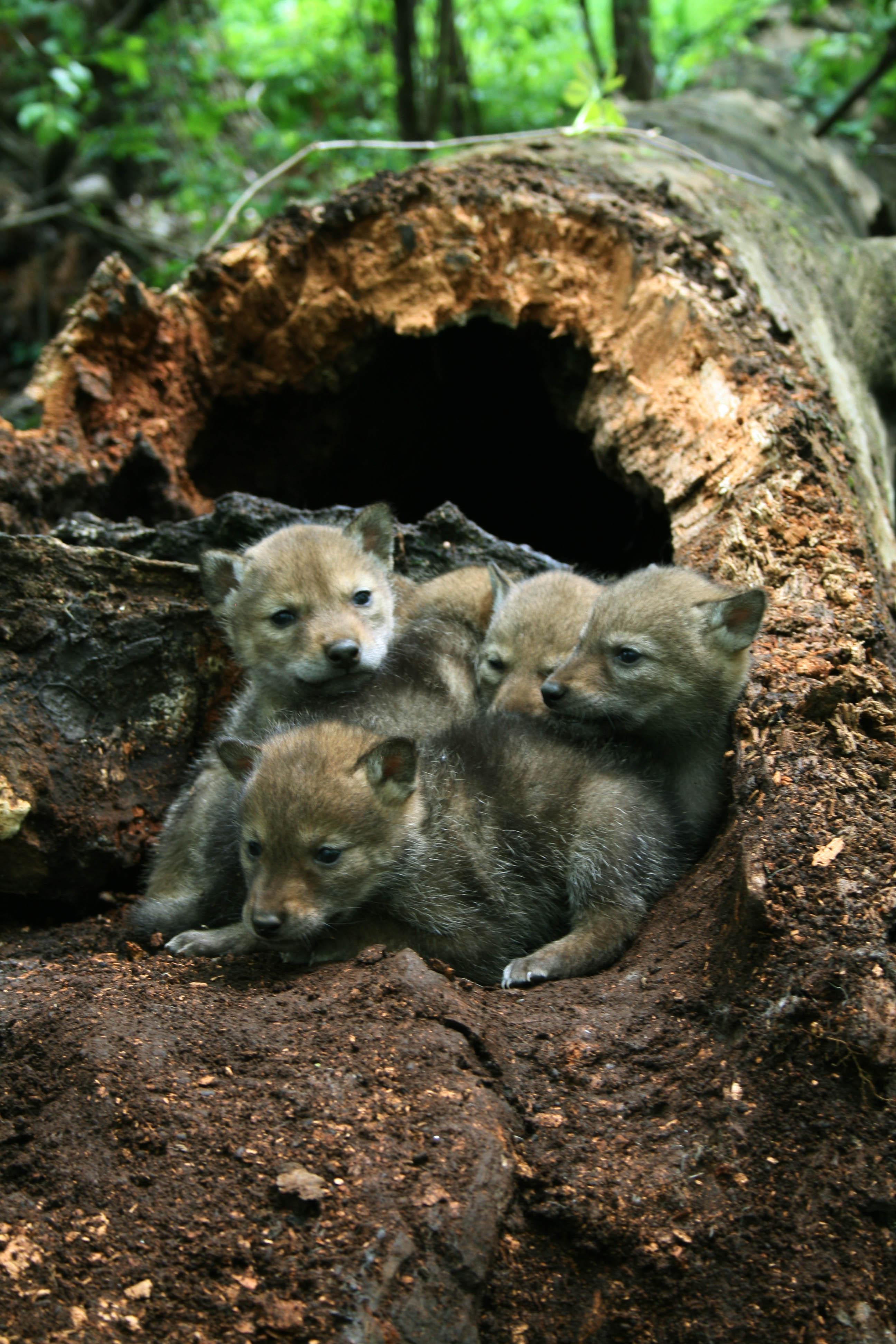
Scientific name: Canis latrans
Clarification
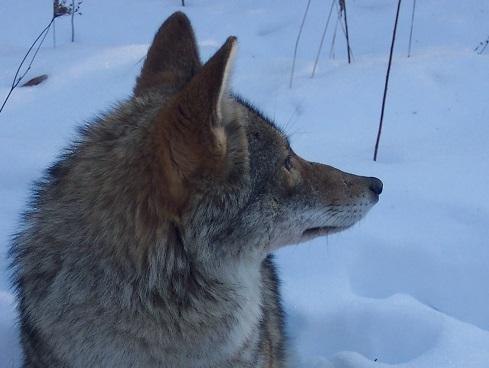
Typical contour: long snout and big upright ears
The coyote is a medium-sized fellow member of the dog family that includes wolves and foxes. With pointed ears, a slender muzzle, and a drooping bushy tail, the coyote oftentimes resembles a High german shepherd or collie. Coyotes are normally a grayish brown with reddish tinges behind the ears and around the face but coloration can vary from a silver-grayness to black. The tail usually has a blackness tip. Optics are yellow, rather than chocolate-brown like many domestic dogs. Most adults weigh between 25-35 pounds, with a few larger individuals weighing up to 42 pounds.
Habitat
Although coyotes can use any habitat, they typically adopt open areas, such as the prairie and desert. Current research is dedicated to understanding coyote habitat option inside urban areas, in order to sympathise if coyotes benefit from human-associated developments (i.e. are synanthropic species) or if they are merely occurring in homo-populated areas due to increased sprawl and fragmentation.
In urban areas, coyotes prefer wooded patches and shrubbery, which provides shelter to hide from people. Our research has constitute that within the urban matrix, coyotes will avoid residential, commercial, and industrial areas only will use any remaining habitat fragments, such every bit those constitute in parks and golf game courses.
Diet
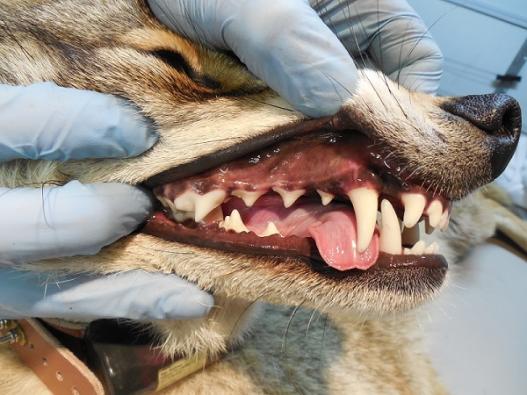
Coyotes can capture large casualty merely volition also feast on berries and plants
Some people believe that urban coyotes primarily eat garbage and pets. Although coyotes are predators, they are too opportunistic feeders and shift their diets to take advantage of the most available prey. Coyotes are generally scavengers and predators of pocket-sized prey but can shift to large prey occasionally. Researcher Paul Morey analyzed scat (fecal matter) contents at different locations within our study area. After investigating one,429 scats, he found that nutrition items varied across space and fourth dimension, which reflects the flexible food habits of coyotes.
The most common nutrient items were pocket-size rodents (42%), fruit (23%), deer (22%), and rabbit (18%). (Scats often take more than than one diet item; therefore, frequencies practice not necessarily add up to 100%). Manifestly, the majority of coyotes in our study area exercise not, in fact, rely on pets or garbage for their diets.
Another way coyote diets tin be adamant is past performing necropsies (like autopsies in people) of deceased coyotes. These are either study animals that died or road-killed animals that are institute; fifty-fifty though they are dead, these coyotes still provide a wealth of cognition about their lives. For diet analysis, the stomach and intestinal tract are investigated to classify and quantify contents. The diet results institute by Morey is oft mimicked by what is institute through necropsy. Rodents are most ever present in the diet, with a mixture of other items depending on the flavor. Breadbasket contents may provide the most exact film of what a coyote is eating considering it is not even so digested and still identifiable. While this only shows the virtually recent meal of any animal, when compared to many other mortalities, results are consistent.
Visit the new research page for information on a novel scientific process we are now using to further investigate diets.
Breeding
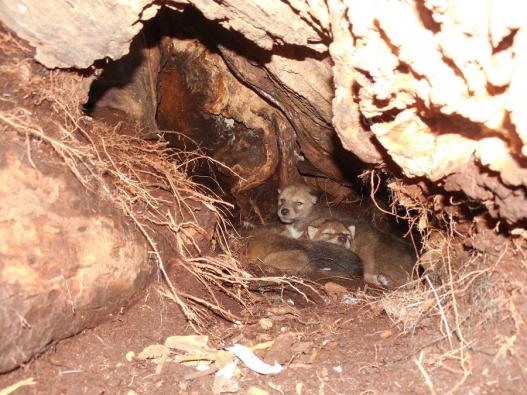
Coyote den case
Mating and Gestation
Coyotes typically mate in February, however, only the alpha pair in a pack volition mate and subordinates will unremarkably help raise the young. Coyotes appear to be strongly monogamous so far, bonds betwixt alpha pairs have only been broken upon the expiry of one of the pair. Therefore, a number of pairs have maintained bonds for multiple years (read the story about coyotes 1 and 115). In April, after a 62 to 65-day gestation period, the female will brainstorm looking for existing dens or dig one herself.
The Den
Pup flavor is the only fourth dimension coyotes volition voluntarily utilize a den; otherwise, coyotes usually slumber higher up basis in the open or in cover. Dens may consist of a hollowed-out tree stump, rock outcrop, or existing couch made past raccoons, skunks or other medium-sized carnivores. Coyotes will too build dens from scratch by earthworks a hole. They normally prefer some protective cover at the den, such every bit bushes or trees, and some type of gradient for drainage. It is not uncommon for mothers to move their immature from den to den to continue them protected or to re-use the same den in multiple years. Some coyotes select secluded areas for their dens, whereas others in more urbanized areas have less selection and may utilize dens about buildings or roads or even in parking lots.
The Litter
Litter sizes often range from four to seven pups, though some litters can be bigger and some smaller. The largest litter found during this study held 11 pups in one den. Coyotes have the ability to conform their litter sizes based on food abundance and population density. While it is difficult to get reliable estimates of litter sizes in urban areas, best estimates suggest that litter sizes are larger than average, indicating an abundant food supply. Pups stay in the den for about half dozen weeks and then brainstorm traveling brusk distances with adults. By the terminate of summer, pups are spending some time away from parents and attempting to chase on their own or with siblings.
Life Expectancy
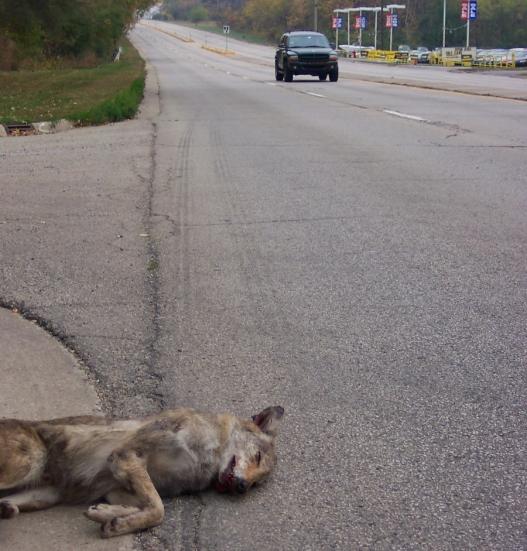
The most common cause of death for urban coyotes
In captivity, coyotes can live xiii to 15 years but in the wild, most die before they achieve three years of age. The oldest confirmed wild coyote so far in this inquiry was an eleven-year-old alpha female, Coyote one. In this study, nosotros plant that coyotes in the Chicago area mostly have a 60% chance of surviving one year. Many pups die from a variety of causes during their first few ventures away from their homes. Survival is fairly consistent among seasons, even during the wintertime. Survival rates of adult coyotes in the Chicago metropolitan area are similar to estimates for coyotes living in rural Illinois. Even so, the survival rates of juvenile coyotes in Melt County are approximately five times higher than the 13% survival rate reported for rural juvenile coyotes. Rural Illinois is dominated by row-crop agronomics and hunting of coyotes occurs year-circular without any regulatory constraints, such every bit bag limits. Given this intensive hunting and trapping pressure plant in rural Illinois, coyote vulnerability is magnified during parts of the year in which substantial encompass/shelter (eastward.chiliad. agricultural crops) is lost due to ingather harvesting. Large metropolitan areas, on the other manus, provide more than year-round protection since at that place is no seasonal loss of habitat via crop harvesting and a lack of intensive hunting pressure level.
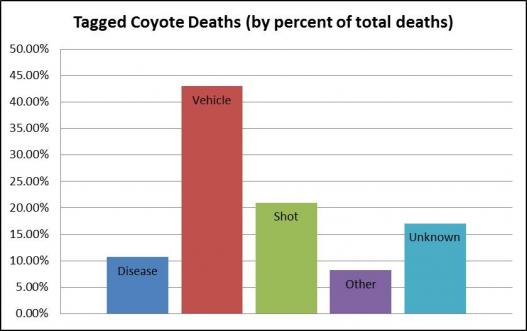
Breakdown of 281 radio-collared coyote deaths (years 2000 to 2014)
By far, the nigh common cause of decease for urban coyotes has been collisions with vehicles (40 to 70% of deaths each year). Given the large areas traversed past coyotes and the number of roads regularly crossed during their activities, this is not surprising. Some of the roads crossed past coyotes in this study have boilerplate traffic volumes of more than than 100,000 vehicles every 24 hours. Other causes of expiry have included shootings and malnutrition; illness is primarily due to mange; and sometimes the death is just too complicated to determine a reason. Few coyotes make it through their full potential life spans, different Coyote 1 who died of natural causes despite existing in a heavily urbanized surface area.
Coyote Social Life
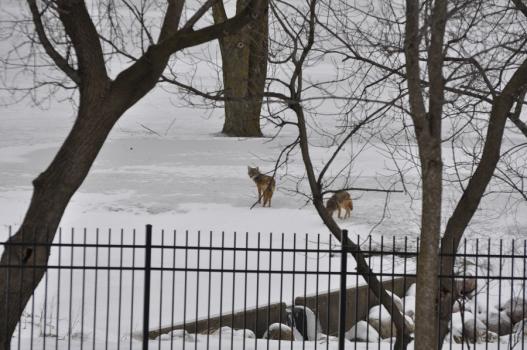
Coyotes can live in packs or as solitary animals
Coyotes typically have a highly organized social system, fifty-fifty in urban areas. This consists of packs, or groups, of coyotes that defend territories from other coyotes. In Cook County, coyotes have been identified as living in packs equally well as traveling alone (alone coyotes). Packs are unremarkably composed of an alpha male and female person pair, and a few other coyotes. Genetic analysis of coyotes has revealed that nearly all pack mates are close relatives, except for the blastoff pair.
Defending Territories
Observations (during tracking, helicopter flights, and trapping) have revealed that the coyotes in this study maintain their territories as groups. Grouping size in protected habitats is typically v to half dozen adults in addition to pups born that year. Territories have very little overlap, and so the coyotes defend these areas from other groups. In rural areas, especially where hunting and trapping are mutual, the group may only consist of the alpha pair and the pups.
Hunting & Travel
Although coyotes live in family groups, they ordinarily travel and hunt solitary or in loose pairs. In this way they are different from wolves, which sometimes leads to the impression that coyotes do non form packs since they are unremarkably seen lonely.
Solitary Coyotes
In improver to resident packs, the urban population also consists of solitary coyotes that take left packs and are looking to bring together groups or create their own territories. Betwixt i-third and one-half of the coyotes studied each year are lonely animals. They tin can be either males or females and are unremarkably young coyotes (vi months to ii years old) but can as well be older individuals who have left packs. Lone coyotes travel over big areas, up to sixty square miles covering many different municipalities; some coyotes may fifty-fifty disperse to different states. These animals must travel between and through, resident coyote territories. Read the story about coyote 571 for an example of this coyote social class.
If a coyote is seen running across a field, it is incommunicable to know if it is a solitary coyote or a member of a pack from that sighting.
Source: https://urbancoyoteresearch.com/coyote-info/general-information-about-coyotes

Post a Comment for "We Are All One Family Wolves and Humans Exhibit"